How to make a sourdough starter
Flour, water, a jar and daily feeding: how to start a sourdough starter, tell when it is ready and keep it going.
- You need
- Flour, water, a jar
- Keep it at
- 21–28 °C (70–82 °F) 2
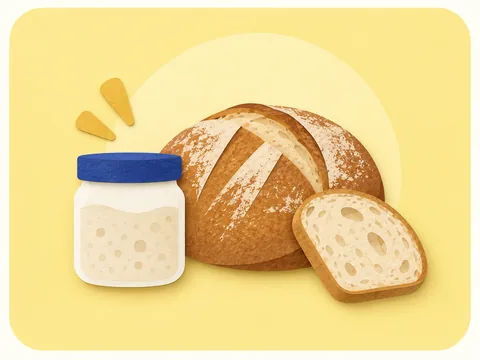
A sourdough starter is a mix of flour and water in which wild yeasts and lactic acid bacteria settle in and multiply. Regular feeding keeps them active until the starter rises predictably enough to leaven bread. 2
You need
- Flour: unbleached rye or whole-grain flour helps a new starter; all-purpose flour also works 21
- Water: roughly the same weight as the flour; the starting mix is 106 g flour to 113 g water 1
Equipment
- A clean glass jar with a loose lid
- Kitchen scale
- A rubber band or tape to mark the level after each feed
Method
Mix flour and water
Stir 106 g flour and 113 g water in a clean jar until no dry flour remains. Cover loosely so gas can escape. 1
Keep it warm
Leave the jar at 21–28 °C (70–82 °F). A cooler kitchen still works, only more slowly. 23
Discard and feed every day
Each day, keep part of the starter and feed it with at least its own weight of flour and of water (1:1:1), for example 50 g starter, 50 g flour and 50 g water. Discard or bake with the rest. From about day 4, feed twice a day. 21
Watch for activity
Bubbles usually appear within 3–5 days. Most starters are reliably active after 7–10 days; some need two weeks or longer to become established. 432
Test before baking
Mark the level right after a feed. When the starter at least doubles within 4–8 hours, smells pleasantly yeasty and is bubbly throughout, it is ready to leaven bread. 25
Settle into a routine
If you bake often, keep feeding daily at room temperature. Otherwise, once the starter is established (after 7–10 days), keep it in the fridge and feed it weekly. Take it out the day before baking and give it one or two feeds 12 hours apart. 32
How to tell it is ready
- It at least doubles within 4–6 hours of a feed in a warm kitchen 21
- Bubbles throughout, a pleasant yeasty smell and a thick, mousse-like texture that pours but is not watery 21
- A spoonful dropped into water floats 13
Storing it
Sources
- Clemson Cooperative Extension HGIC: How to make, feed and bake with a sourdough starterStarting mix of 106 g flour and 113 g water; 1:1:1 feeding; bubbling by day 3; doubles in 4–6 hours; float test; daily or weekly feeding; uses for discard. Accessed 2026-10-09.
- University of Illinois Extension: Sourdough bread 101Feeding at least 1:1:1 starter:flour:water; 21–28 °C (70–82 °F); established in 14 days to a month, usable from day 7; doubles in 4–6 hours; hooch; discard mould; drying is better than freezing for long breaks. Accessed 2026-10-09.
- South Dakota State University Extension: Sourdough startersAbout 21 °C (70 °F); active in 7–10 days on average; refrigerate only once established and feed weekly; discard if mouldy, foul-smelling or with green, pink or orange spots. Accessed 2026-10-09.
- Washington State University Bread Lab: Sourdough starterEqual volumes of flour and water, fed twice daily; bubbles within 3–5 days; active after about 5 days. Accessed 2026-10-09.
- Colorado State University Extension: Caring for your starterAn active starter doubles in 5–8 hours depending on room temperature; refrigerated starter is fed weekly. Accessed 2026-10-09.
- US FDA: Flour is a raw food and other safety factsDo not eat or taste raw flour, dough or batter; it can carry Salmonella and E. coli. Accessed 2026-10-09.
- Colorado State University Extension: Sourdough starter best practicesHooch is a sign of hunger; mould means do not use, clean and restart; do not taste raw starter. Accessed 2026-10-09.
- US CDC: Raw flour and doughGerms in flour are killed only when it is baked or cooked. Accessed 2026-10-09.
Numbers on this page come from these sources. Where sources give a range, we quote the range rather than a single figure.