How to make sauerkraut at home
Cabbage, salt and a weight: the tested home method for sauerkraut, with salt by weight, fermenting temperatures and times, and the signs that it is done.
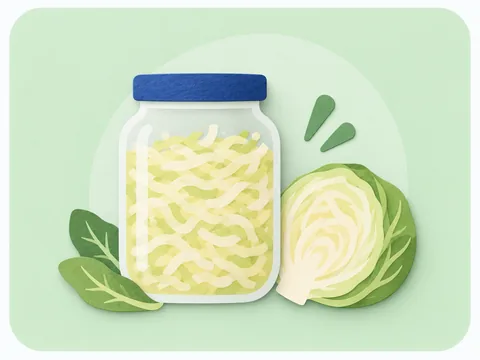
Sauerkraut is cabbage preserved by lactic acid bacteria. Salt draws out the cabbage juice and holds back spoilage microbes, the brine keeps air away, and the bacteria sour the cabbage over several weeks until its pH falls to 4.6 or below. 12
You need
- Fresh cabbage, ideally 24–48 hours after harvest; weigh it after trimming 1
- Canning or pickling salt: 3 tablespoons per 5 lb (2.27 kg) of cabbage, or 2.25–2.5% of the trimmed cabbage weight 12. Iodised table salt is safe but may cloud the brine; flake salt and reduced-sodium salt are not recommended 3
Equipment
- A food-grade glass or plastic container, about 1 gallon (3.8 L) for every 5 lb of cabbage, with the rim 4–5 inches (10–13 cm) above the cabbage; never aluminium, copper, brass, galvanised or iron 412
- A weight: a plate held down with water-filled jars, or a food-grade bag filled with brine 3
- A clean cloth to cover the container
Method
Trim and shred
Remove the outer leaves, rinse the heads under cold running water, cut out the cores and shred the cabbage to about the thickness of a quarter coin. 1
Weigh and salt
Weigh the shredded cabbage and mix in salt at 2.25–2.5% of its weight, about 3 tablespoons for 5 lb. Work with about 5 lb at a time. 21
Pack
Pack the cabbage firmly into the container until the salt draws out enough juice to cover it. 1
Top up if needed
If the juice does not cover the cabbage, add boiled and cooled brine made with 1½ tablespoons of salt per quart (about 1 litre) of water. 3
Weigh it down
Keep the cabbage 1–2 inches (2.5–5 cm) under the brine with a weighted plate or a brine-filled bag, and cover the container with a clean cloth. 13
Ferment
Keep at 21–24 °C (70–75 °F) for about 3–4 weeks, or at 16–18 °C (60–65 °F) for 5–6 weeks. Below 16 °C it may not ferment; above 24 °C it may go soft. 1
Check the surface
If you weigh it with a plate, check 2–3 times a week and remove any scum that forms. A brine-filled bag can be left undisturbed until fermentation ends. 13
How to tell it is ready
- Bubbling has stopped 1
- A clean, sour smell and taste and a firm texture 5
- pH 4.6 or below, if you test 2
Storing it
- Keep tightly covered in the fridge, where it keeps for several months 1
- Small jars work, but extension guides note they give more spoilage losses than a larger crock 3
Other vegetables
The same principle applies to other vegetables: enough salt, no air, a steady cool room. Whole or cut vegetables are covered with a measured brine rather than dry-salted; the salt calculator works out both. For pickles and other vegetables, follow a tested recipe from the National Center for Home Food Preservation rather than improvising the salt. 3
Sources
- National Center for Home Food Preservation: Sauerkraut5 lb cabbage to 3 tablespoons canning or pickling salt; pack until juices cover; keep 1–2 inches under brine; 3–4 weeks at 70–75 °F (21–24 °C), 5–6 weeks at 60–65 °F (16–18 °C), may not ferment below 60 °F and may soften above 75 °F; remove scum 2–3 times a week; done when bubbling stops; keeps several months refrigerated. Accessed 2026-10-09.
- Clemson Cooperative Extension HGIC: Want to ferment vegetables? Start with sauerkrautFinal salt concentration of 2.25–2.5%; proper fermentation lowers the pH to 4.6 or below; do not use aluminium, copper, brass, galvanised or iron containers. Accessed 2026-10-09.
- USDA Complete Guide to Home Canning, Guide 6: Fermented foods and pickled vegetablesTop-up brine of 1½ tablespoons salt per quart of water, boiled and cooled; canning or pickling salt; jars are acceptable but give more spoilage losses; a brine-filled food-grade bag as weight; discard pickles that turn soft, slimy or smell disagreeable. Accessed 2026-10-09.
- National Center for Home Food Preservation: Suitable containers, covers and weightsOne gallon of container per 5 lb of vegetables; food-grade glass or plastic; weights that keep vegetables under the brine. Accessed 2026-10-09.
- Oregon State University Extension: Sauerkraut problems and solutions (SP 50-745)Soft kraut from too little salt (below 1.7%), uneven salting, high temperature or air pockets; slimy kraut is discarded; rotten surface layers are removed; discard if large amounts of mould are visible. Accessed 2026-10-09.
- NC State Extension: Pickle and pickle product problemsSlimy and mouldy pickles and pink kraut are unsafe; a white film of yeast on the brine surface is not harmful; too much salt, over 2.25%, can cause pink kraut. Accessed 2026-10-09.
Numbers on this page come from these sources. Where sources give a range, we quote the range rather than a single figure.
A new, independently written method at the address previously used for “Sauerkraut”.