How to make kombucha at home
Sweet tea, a SCOBY and starter liquid: the tested home kombucha recipe, with temperatures, timing, flavouring and the cautions that matter.
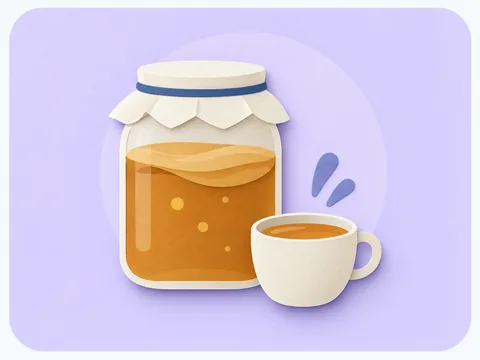
Kombucha is sweetened tea fermented by a SCOBY, a symbiotic culture of bacteria and yeasts, together with acidic starter liquid from an earlier batch. The tested recipe below comes from the National Center for Home Food Preservation; follow it as written rather than scaling it down. 12
You need
- 1 gallon (3.8 L) water 1
- 3 tablespoons black tea (6 bags) and 1/3 cup plus 2 tablespoons green tea (13 bags) 1
- 1 cup granulated sugar 1
- A SCOBY and starter liquid from a previous batch. The starter must be at pH 4.0 or lower; if it is higher, discard it 1
Equipment
- A glass vessel of at least 1.5 gallons (5.7 L); not glazed earthenware, which can leach heavy metals 24
- pH strips
- A paper towel, coffee filter or cheesecloth and a rubber band 1
Method
Check the starter
Test the starter liquid with a pH strip. It must read 4.0 or lower; if it is higher, discard it. 1
Brew the tea
Heat 4 cups of the water to 71–77 °C (160–170 °F) and steep the tea for 2 minutes. Remove the tea. 1
Sweeten and cool
Stir in the sugar until it dissolves, add the remaining 12 cups of cold water and let it cool below 35 °C (95 °F). 1
Add the culture
Pour the tea into the vessel and add the SCOBY and the starter liquid. 1
Cover
Cover with a paper towel, coffee filter or cheesecloth held by a rubber band. Never seal it airtight. 12
Ferment
Keep at 20–25 °C (68–77 °F), away from vents and direct sun, for 7–10 days. 12
Taste and bottle
Taste from about a week on. When it is pleasantly tart, reserve 20% of the liquid and the SCOBY for the next batch and refrigerate the rest. 32
How to tell it is ready
- Bubbles, a tangy aroma and a slightly sour taste; a new SCOBY may form on the surface 2
- It tastes tart rather than sweet; longer fermentation makes it more acidic and raises the alcohol 2
Storing it
- Refrigerate at 4 °C (40 °F) or below and drink within 30 days; flavoured kombucha within 2 days 12
- Keep a SCOBY for the next batch in starter liquid under a cloth, not in an airtight container 2
Flavouring
For a flavoured, fizzier kombucha, add 10–20% fruit juice or fruit to the finished tea, cap it and leave it for 1–3 days at room temperature, then refrigerate. 3 Open the caps once a day to release pressure. 5 Flavoured kombucha keeps only about 2 days. 2
Sources
- National Center for Home Food Preservation: Kombucha teaTested recipe: 1 gallon water, black and green tea, 1 cup sugar, SCOBY and starter liquid of pH 4.0 or lower; steep at 160–170 °F (71–77 °C), cool below 95 °F (35 °C); ferment 7–10 days at 68–77 °F (20–25 °C) under a cloth; refrigerate; airtight storage can lead to explosion. Accessed 2026-10-09.
- NCHFP / University of Georgia: Crafting kombucha at home, FAQUse a vessel of at least 1.5 gallons; half batches are not recommended and gave excessive acidity; reserve 20% of the liquid and the SCOBY; signs of fermentation; tested batches below 0.016% alcohol, more with longer fermentation; refrigerate and use within 30 days, flavoured within 2 days; do not store a SCOBY airtight. Accessed 2026-10-09.
- UC ANR Master Food Preservers: KombuchaFerment 7–14 days at 64–79 °F (18–26 °C), tasting after a week; for flavouring add 10–20% juice or fruit, cap 1–3 days at room temperature, then refrigerate; longer capped at room temperature risks pressure and explosion. Accessed 2026-10-09.
- University of Georgia Extension: What’s the word on homemade kombucha? (C 1312)Do not use glazed earthenware; discard tea and SCOBY with dry, fuzzy mould of any colour; people with weakened immune systems or susceptibility to acidosis, and pregnant or breastfeeding people, are advised against homemade kombucha. Accessed 2026-10-09.
- Utah State University Extension: Homemade kombuchaOpen flavoured, capped bottles once a day to release carbon dioxide pressure. Accessed 2026-10-09.
- TTB: KombuchaKombucha at 0.5% alcohol by volume or more at any time during production or after bottling is an alcohol beverage. Accessed 2026-10-09.
Numbers on this page come from these sources. Where sources give a range, we quote the range rather than a single figure.